
Tokenomics: what AI work costs across 19 models and seven routes
The same two tasks priced on 19 models through vendor APIs, OpenRouter, the clouds, third-party hosts, Kiro, Antigravity and flat plans, checked against 15,067 public prices on 18 October 2026.
Key takeaways
- Spend flat plans and free pools first; when you pay per token, the route can matter more than the model.
- Open models vary up to 25 times in price between hosts for the same model.
- Kiro's credits ran 2 to 10 times cheaper than Anthropic's list price on Claude 4.5 models.
- 23 public feed prices disagreed by more than 5% for the same host and model.
On 18 October 2026 I priced the same two tasks across 19 models and seven ways of buying them: the model maker's own API, OpenRouter, the big cloud platforms, the cheapest third-party host, Kiro's credits, Antigravity's free pools, and flat monthly plans. 15,067 public prices from four feeds sit underneath it, plus live probes where a route has no published price.
The short version: spend flat plans and free pools first. When you do pay per token, the route can matter more than the model.
Six findings
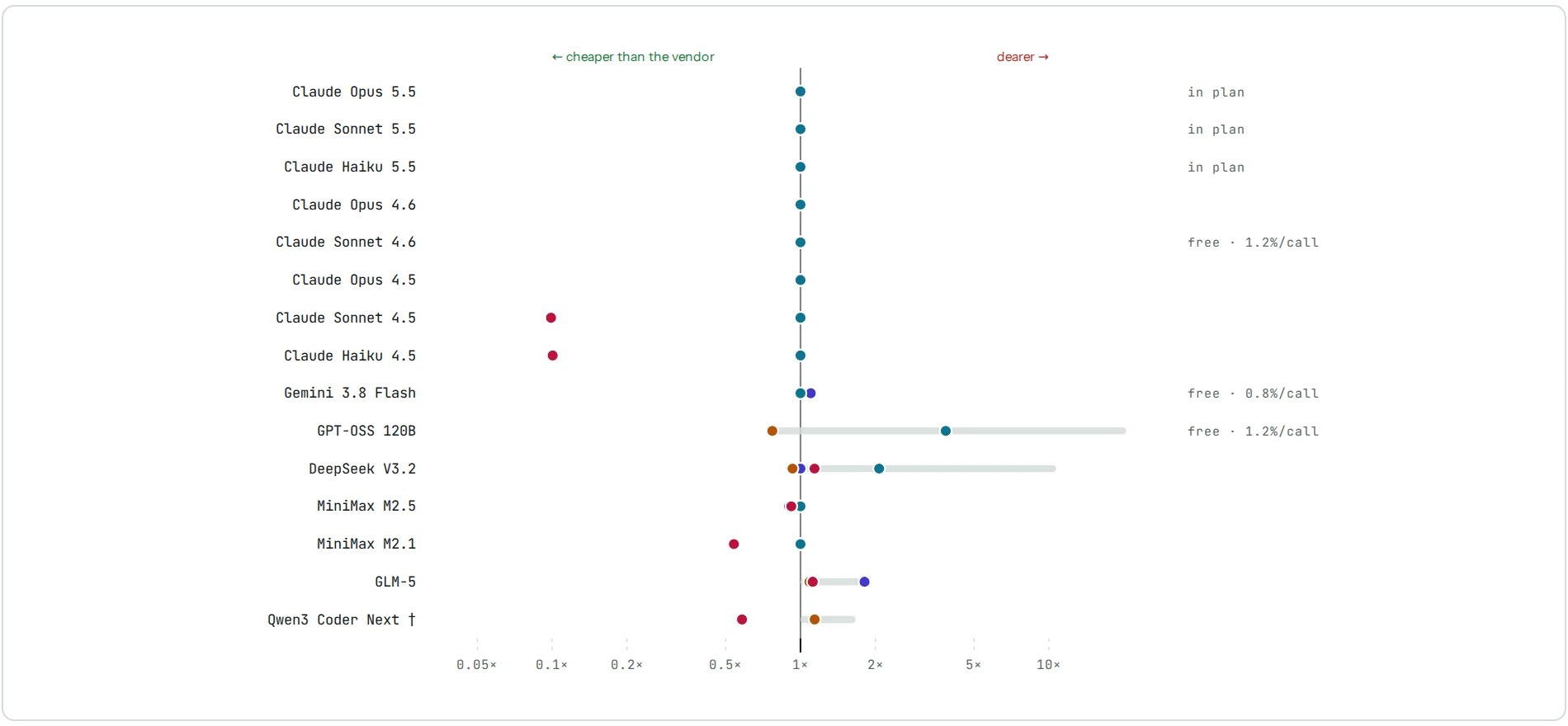
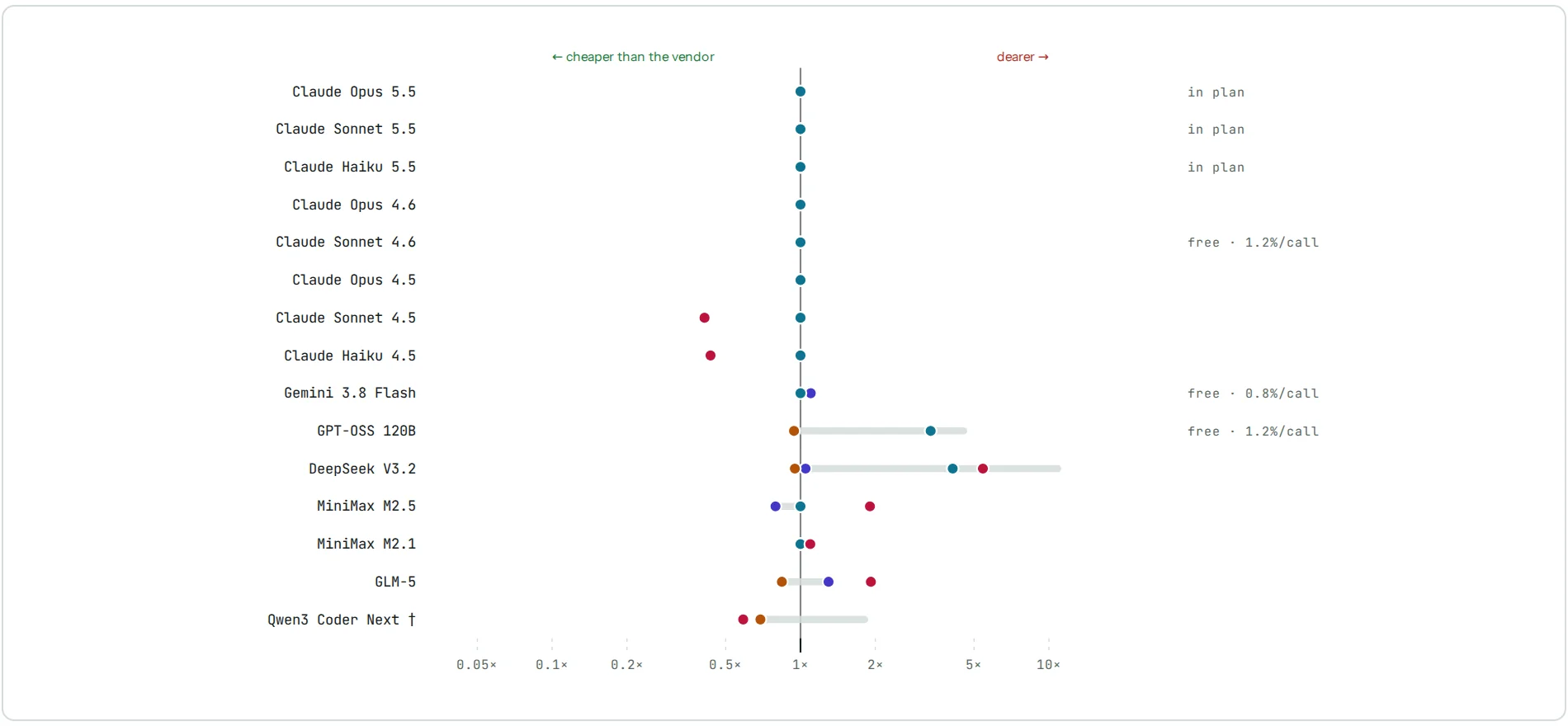
- Kiro's free credits go further than they look. On Claude 4.5 models Kiro charged 2 to 10 times less than Anthropic's list price for the same request, even at the $0.04 overage rate.
- Haiku 5.5 is the cheapest Claude for long outputs: $0.10 in and $0.50 out per million tokens on the Anthropic API, the lowest Claude price on any route tracked. Kiro does not offer Claude 5 models.
- Open models vary up to 25 times by host. GPT-OSS 120B is $0.03 per million input tokens on some hosts and $0.80 on others; DeepSeek V3.2 ranges from $0.23 to $3.00.
- Kiro's charges moved 40% in one day. The same 16 calls cost about 40% less in the afternoon than in the morning. One measurement is not a price, so the tool keeps re-measuring.
- Public price feeds disagree, and some are stale. 23 prices differ by more than 5% between feeds for the same host. genai-prices still listed OpenAI o3 at $10 and $40 while two other feeds showed $2 and $8.
- Antigravity's free pools last about 85 to 125 calls a week. Each short call used about 1.2% of the weekly Claude and GPT pool, or about 0.8% of the Gemini pool.
How the comparison works
Every model gets two fixed tasks. The input-heavy task sends about 8,700 tokens (the GPL-3 licence text) and asks for a five-token reply. The output-heavy task sends 40 tokens and asks for about 560 back. Each route's cost is the task's tokens times that route's published rate or, where there is no rate, the credits or pool share a live probe actually used. Kiro is priced at its $0.04 overage rate per credit.
Route map: 19 models, seven routes
| Model | Vendor API | OpenRouter | Cloud | Cheapest host | Kiro | Antigravity |
|---|---|---|---|---|---|---|
| Claude Opus 5.5 | $0.0349 / $0.0114 | $0.0349 / $0.0114 | Bedrock $0.0349 / $0.0114 | — | — | — |
| Claude Sonnet 5.5 | $0.0175 / $0.0057 | $0.0175 / $0.0057 | Bedrock $0.0175 / $0.0057 | — | — | — |
| Claude Haiku 5.5 | $0.0009 / $0.0003 | $0.0009 / $0.0003 | Bedrock $0.0009 / $0.0003 | — | — | — |
| Claude Opus 4.6 | $0.0436 / $0.0142 | $0.0436 / $0.0142 | Bedrock $0.0436 / $0.0142 | — | — | free |
| Claude Sonnet 4.6 | $0.0262 / $0.0085 | $0.0262 / $0.0085 | Bedrock $0.0262 / $0.0085 | — | — | free · 1.2%/call |
| Claude Opus 4.5 | $0.0436 / $0.0142 | $0.0436 / $0.0142 | Bedrock $0.0436 / $0.0142 | — | — | — |
| Claude Sonnet 4.5 | $0.0262 / $0.0085 | $0.0262 / $0.0085 | Bedrock $0.0262 / $0.0085 | — | $0.0026 / $0.0035 | — |
| Claude Haiku 4.5 | $0.0087 / $0.0028 | $0.0087 / $0.0028 | Bedrock $0.0087 / $0.0028 | — | $0.0009 / $0.0012 | — |
| Gemini 3.8 Flash | $0.0065 / $0.0021 | $0.0072 / $0.0023 | Vertex $0.0065 / $0.0021 | — | — | free · 0.8%/call |
| GPT-OSS 120B | $0.0003 / $0.0001 | $0.0013 / $0.0003 | Azure $0.0013 / $0.0003 | Wandb $0.0003 / $0.00010 | — | free · 1.2%/call |
| DeepSeek V3.2 | $0.0024 / $0.0002 | $0.0024 / $0.0002 | Azure $0.0051 / $0.0010 | Deepinfra $0.0023 / $0.0002 | $0.0028 / $0.0013 | — |
| MiniMax M2.5 | — | $0.0024 / $0.0005 | Bedrock $0.0026 / $0.0007 | Minimax $0.0026 / $0.0007 | $0.0024 / $0.0013 | — |
| MiniMax M2.1 | — | $0.0026 / $0.0007 | Bedrock $0.0026 / $0.0007 | Minimax $0.0026 / $0.0007 | $0.0014 / $0.0007 | — |
| GLM-5 | $0.0048 / $0.0014 | $0.0087 / $0.0018 | — | Deepinfra $0.0052 / $0.0012 | $0.0054 / $0.0027 | — |
| Qwen3 Coder Next | $0.0017 / $0.0008 | $0.0010 / $0.0005 | — | Aihubmix $0.0012 / $0.0003 | $0.0006 / $0.0003 | — |
| GPT-5.6 | $0.0349 / $0.0114 | — | — | — | — | — |
| GPT-5.6 Luna | $0.0017 / $0.0007 | $0.0017 / $0.0007 | — | — | — | — |
| GPT-5.6 Terra | $0.0175 / $0.0068 | $0.0175 / $0.0068 | — | — | — | — |
| GPT-5.6 Sol | $0.0349 / $0.0114 | $0.0349 / $0.0114 | — | — | — | — |
For the newest Claude models and the GPT-5.6 family, only the vendor API and OpenRouter list a price, and they list the same one, so the route makes no difference there.
Where each route wins
Each dot below is what one task costs on that route, relative to the vendor's own API price for the same task (1×). Left of the line is cheaper, right is dearer, and the grey bar runs from the cheapest to the dearest of the 24 hosts tracked for that model. The scale is logarithmic.
How I split work: three layers
- Flat plans with use left: MiniMax M3 for bulk work, Codex for review, Claude for judgment. Here the question is use left, not dollars.
- Free and weekly allowances: Kiro's 50 credits on Claude Haiku 4.5 or Qwen3 Coder Next for short public questions, Antigravity's pools, and Grok's weekly allowance for occasional web research.
- Pay per token: Haiku 5.5 on the API, or OpenRouter, only when the first two layers are used up or a task needs a model they lack. Never chosen automatically.
What a week of agent work looks like
From 12 to 18 October my agents used 11.4 billion tokens, up 139% on the week before. 98% of that was read back from prompt caches; 268 million tokens were new input, output or cache writes. Most of the volume is the same working context read again at each step of a task, not new writing.
For scale, a billion tokens is roughly 750 million words of English, about 7,500 novels. Billed at Claude Opus 5.5's API list prices, the week would have cost about $4,006, because cache reads bill at a twentieth of the normal input price.
| Engine | Total | New | Output | Calls | vs prior 7 days |
|---|---|---|---|---|---|
| MiniMax M3 | 6.9B | 119M | 22.4M | 48,173 | +136% |
| Claude | 3.5B | 89.7M | 14.4M | 17,147 | +124% |
| Codex | 1.0B | 59.2M | 2.5M | 8,787 | +261% |
| Grok | 240K | 162K | 5.9K | 14 | new |
| Antigravity | 90.6K | 90.6K | 17.6K | 15 | new |
| NVIDIA NIM | 4.8K | 4.8K | 4.2K | 3 | −96% |
Published price tools and research
LiteLLM (MIT, 10,099 prices including cache and batch tiers), genai-prices from Pydantic (MIT, 2,938 prices with history), OpenRouter's model list (1,552 live reseller prices), and llm-prices.com by Simon Willison (478 hand-maintained prices) together cover per-token API pricing well. Subscriptions and credit plans appear in none of them.
Artificial Analysis measures the dollar cost to run its evaluation suite per model and publishes its methodology. That approach captures the difference between list price and task cost: two models at the same list price can differ about 10 times per completed task because one writes more tokens or needs a second attempt.
SemiAnalysis measured what Claude and ChatGPT plan limits are worth at API prices by watching the usage meter (5 October 2026, paywalled). The Claude Max meter with Opus 5.5 came to about $11,700 a month of API-equivalent value; ChatGPT Pro came to about $2,100.
Slobodianiuk tested the Claude Max meter independently and found output tokens weighing about 850 times a cache read, against about 50 times at API prices. If that ratio holds across workloads, cache-heavy agent sessions would stretch a subscription further than output-heavy sessions.
Chen et al. (FrugalGPT, 2023) proposed sending requests to a cheap model first and escalating on failure. Ong et al. (RouteLLM, 2024) achieved an 85% cost reduction at 95% MT-Bench quality by learning to route between a strong and a weak model; the code has not been updated since 2024. Not Diamond and OpenRouter Auto are live per-request routers. Subscriptions and credit plans are outside the scope of all four.
Observations on comparing costs
Artificial Analysis's methodology shows that per-token price alone does not predict task cost. A model that writes twice as many tokens or needs a second attempt costs more at a lower list price.
Kiro's auto-routing cost about 2 times the cheapest named model and did not disclose which model answered. Named model selection produced lower and more predictable costs on this platform.
Switching models mid-conversation discards the prompt cache on providers that support caching (Anthropic, Google). Slobodianiuk's meter test suggests cache reads cost close to zero against a subscription meter, so keeping a long conversation on one model preserves that advantage.
Research quality by lane
On 18 October, each lane received the same question: what tools for comparing LLM costs already exist? Grok returned about 40 dated sources and flagged claims it could not verify. Kiro on Haiku 4.5 returned sourced results with three misattributions. Antigravity on Gemini Flash returned organized categories with no source links. A local Nemotron model returned 2024-era knowledge with links and license names that did not exist.
Safety and reliability
Kiro's tool-disable setting did not prevent web search on 18 October. I replaced that setting with a wrapper that refuses output if the model invokes a tool. The wrapper exposed no non-public text during the incident.
Grok's "no tools" flag had no effect. A second wrapper blocks tools by name and stops the probe if Grok still offers one.
Kiro reported two different usage totals. Per-call records summed to 0.97 credits across the run; the usage endpoint rose 0.50 (from 1.34 to 1.84). The platform labels its usage endpoint an estimate. The tool records both readings until the billing basis is confirmed.
Small test fixtures passed on the first attempt. The full price feeds and the first live run exposed eight bugs; the probe wrappers failed to receive the HOME environment variable, which caused all probes to error. Each fix has a regression test. The suite now includes 301 offline tests.
Next
The tool re-runs on demand whenever a new model or price appears, and the report is regenerated from the same data. The last milestone is a routing-policy helper that proposes changes to which engine gets which work from live allowance data; I approve each change before it takes effect.
Sources
- LiteLLM model prices and context window (MIT)Retrieved 2026-10-18.
- pydantic genai-prices (MIT, price history)Retrieved 2026-10-18.
- OpenRouter model list (live reseller prices)Retrieved 2026-10-18.
- llm-prices.com (Simon Willison, hand-maintained)Retrieved 2026-10-18.
- Artificial Analysis methodologyRetrieved 2026-10-18.
- SemiAnalysis: Anthropic subscriptions offer 5x (5 Oct 2026)(2026). Retrieved 2026-10-18.
- Slobodianiuk: I measured the Claude Max meter (Medium)Retrieved 2026-10-18.
- Chen et al.: FrugalGPT (2023)Lingjiao Chen; Matei Zaharia; James Zou. (2023). Retrieved 2026-10-18.
- Ong et al.: RouteLLM (2024)(2024). Retrieved 2026-10-18.
- Cascade routing (ICML 2025)(2025). Retrieved 2026-10-18.